New Pipe-in-Pipe Design Ensures Effective Insulation

Increasing demand for energy, matched with high commodity prices and advances in technology, are driving operators to extract whatever reserves remain in the challenging UK continental shelf. Therefore, the requirement to transfer these multi-phase products from often high-pressure/high-temperature (HP/HT) wells back onshore is an even more demanding prospect.

Up until now, the common belief in the industry was that pipe-in-pipe systems able to withstand environmental challenges such as corrosion, structural integrity, and thermal management, would be too costly and complex to apply to riser systems.

Tata Steel worked closely with supply partners to engineer, procure, and construct these assemblies to further develop this innovative technology as a cost-effective solution to flow assurance issues.

Need for insulation

HP/HT fields are technically more complex to develop because of the inherently higher energy in the well fluid and its multi-phase composition. Managing the extreme pressure and operating temperature must be based and evaluated on criteria such as corrosion, maintaining structural integrity, and thermal management.

One particular challenge is the management of pipeline shutdown. Less expensive solutions for managing the insulation of bends such as wet coatings, compromise overall shutdown times due to reduced thermal efficiency. Solutions, such as “self-draining” spools, present a significant design challenge that can be mitigated by the inclusion of pipe-in-pipe bends, enabling the same thermal integrity to be maintained in the whole line.

Tata Steel has previously implemented a solution for pipe-in-pipe bends for a North Sea development. Since then, new insulation techniques have been developed that give far superior insulation properties.

Risers, spools, and bends

The main challenge with the construction of pipe-in-pipe bends is how to pass the inner flowline bend into the outer casing pipe. It is important that pipe bends have a straight portion on the end to enable efficient welding to the next pipe section and this can present the insertion of one bend into the other.

The second construction challenge is efficient insulation. Wrapping or sheathing is simply not practical here as the insulation would occupy the annulus of the assembly and prevent the integration.

New insulation system

Drawing of the geometry of one pipe into another.

The system developed by Tata Steel overcomes these problems by deploying granular Nanogel insulation into the annulus of the pipe-in-pipe system. Nanogel is made by first forming a silica gel, then expelling the water from the silica matrix. The resulting material is granular with trapped nanopores of air, inhibiting heat transfer by conduction, convection, and radiation (with the inclusion of an opacifier).

The deployment of a novel polymeric bulkhead, cast directly into the annulus, provides a solid barrier to retain the insulation, which allows for the relative movement of the inner and outer bends. The polymer is a “syntactic” material, silicone rubber with glass microspheres dispersed through the matrix with high strength, flexibility, and thermal efficiency. The tangent ends of the inner and outer bends are held rigidly to ensure that the assembly tolerances achieved at manufacture are retained when the unit is transferred to the welding contractor for incorporation into the pipeline spool or riser.

In order for the insulation to be effectively deployed and provide the consistent thermal performance, the annular gap throughout the assembly must be uniform. It is important the manufacturing tolerances of the pipe and bends are closely controlled.

Steel pipe and bend manufacture

Together with Tata Steel, Eisenbau Krämer (EBK) and the pipe bending plant of Salzgitter Mannesmann Grobblech (SMGB) have developed a series of controls, including a process and measurement system, to ensure all bend dimensions are closely controlled and mating bends can be produced, matched, and paired to ensure the most accurate assembly is produced.

In respect to the process-related thinning in the extrados of the hot induction bends, the wall thickness for the inner and outer mother pipes was increased accordingly. To match precisely, the mother pipes have been manufactured with the same ID as the riser pipes.

16-in. clad bends being transferred to the quenching tank after austenitization at SMGB pipe bending mill.

EBK supplied Tata Steel with the mother pipe, which has material properties that allow formation through hot induction bending. The main material challenges are to ensure the mechanical properties are suitable after bending. Therefore, SMGB is taking responsibility for the chemical design of the pre-material. This also involves the consideration of a series of heat treatment and forming processes. EBK uses a multi-pass welding process and steel plate from premium mills in Europe. The manufacturing process at EBK generates pipe of the closest dimensional control through a series of cold forming and sizing operations such as external calibration.

At the SMGB pipe bending plant, the special mother pipes are bent by hot induction bending. Heat is applied through electrical induction to the mother pipe materials and the pipe is slowly formed to give the correct geometry. In most pipeline applications the critical dimensions are the positions and attitudes of the ends of the bends (center-to-end dimension) to maintain the overall geometry of the pipeline. However, with pipe-in-pipe bends it is important that the bend radius is also accurately controlled to ensure the two bends can be integrated. The precise dimensions after bending also need to be maintained following heat treatment. For the inner clad bends, a full-body quench and temper heat treatment is applied at the SMGB bending mill in order to guarantee homogenized material properties for the bends, to fulfill mechanical and corrosion requirements.

HP/HT material properties

Additional material complexities have to be overcome. Generally, in HP/HT lines there are challenges because of corrosion, low temperature toughness, and strength. These parameters require careful material selection to maintain the balance of properties from the outset through to bend production. Thermal stresses need to be managed as the loads are shared between inner and outer pipe. In addition, the insulation can lead to extremes of temperature being retained in the pipe materials during operation and shutdown that can form challenging conditions for conventional steel products.

Conclusion

HP/HT well environments present some of the most challenging and technologically demanding conditions for field developments, not least because the properties in each reserve offer significant challenges in terms of material selection and design.

Tata Steel and its supply partners have expanded capabilities further with the design and creation of cost-effective insulated pipe-in-pipe bends for risers and spools – an accomplishment previously considered too difficult.

Pipe-in-pipe bends, while challenging technologically, can lead to simplification of overall pipeline design and can give better pipeline performance in times of operation and shutdown.

(source:http://www.offshore-mag.com/articles/print/volume-73/issue-4/engineering-construction-installation/new-pipe-in-pipe-design-ensures-effective-insulation.html)

Fatigue Free Span Analysis

Construction of unburied pipeline is the most common method in offshore pipeline system. Unburied pipeline should be designed appropriately due to the bathymetry condition. And it is inevitable founding the existence of free span. Free spanning in offshore pipelines mainly occurs as a consequence of uneven seabed and local scouring due to flow turbulence. An illustration of free span is showed by the figure below:

post8-4

According to Fredso and Sumer (1997), resonance is the main problem for offshore pipelines laid on the free spanning. Resonance happens when the environment’s frequency becomes equal to the pipe natural frequency. Resonance may lead to develop more fatigue on pipelines. In order to reduce the risk caused by free spanning, a maximum allowable length of free span should be determined. Span length is described with the following image:

post8-7

An allowable length of free span can be calculated by the following formula (DNV 1998 & ABS 2001) :

post8-1

in which

  • E = modulus of elasticity;
  • I = bending moment of inertia pipeline;
  • C = coefficient of seabed condition;
  • Vr = reduced velocity (Fredso and Sumer, 1997).

Vr defined as:

post8-2

where

  • U = streamwise flow velocity;
  • D = outer diameter of pipe;
  • me = effective mass (including structural mass, mass of content and added mass);
  • fn = natural frequency of the pipe free span.

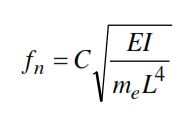
Natural frequency of free span pipe defined as:

post8-3

In practice, the use of these formula for estimation of maximum free span length is not very applicable since there is difficulties in determining the exact seabed conditions.Therefore, different approaches usually adopted. One of the method is modal analysis.

Modal Analysis

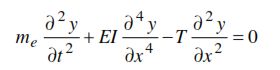
Natural frequency of pipelines can be obtained using the Euler-Bernoulli beam equation which is defined as (Xu et al, 1999 and Bai, 2000):

post8-5

with y = in-line displacement of pipe; x = position along the pipe span; t = time; C = total damping ratio; T = axial force of pipe (positive under tension); and F(t,u,y) = total external forces.

External forces and damping ratio only influence the resonance amplitude, so it can be ignored and the pipe free vibration equation is expressed in the following equation:

post8-6

There are several codes that can be used as reference containing free spanning on offshore pipeline, like DnV RP F105 (Pipeline Free Spanning) and API RP 11 11, 1999.

PREVENTION

In order to prevent crack due to free spanning, supports can be made to reduce the stress on the free span area. These supports include sand-filling or mini structure. A mini structure is shown in figure below:

post8-8

(source:https://nonerieska.wordpress.com/2013/01/31/free-span-fatigue-analysis/)

Hydrotest On Offshore Pipeline

A hydrostatic test is a way in which pressure vessels such as pipelines, plumbing, gas cylinders, boilers and fuel tanks can be tested for strength and leaks. The test involves filling the vessel or pipe system with a liquid, usually water, which may be dyed to aid in visual leak detection, and pressurization of the vessel to the specified test pressure. Pressure tightness can be tested by shutting off the supply valve and observing whether there is a pressure loss. The location of a leak can be visually identified more easily if the water contains a colorant.
it is essential to identify the limits of the test process and obtainable results. There are several types of flaws that can be detected by hydrostatic testing, such as:
  • Existing flaws in the material,
  • Stress Corrosion Cracking (SCC) and actual mechanical properties of the pipe,
  • Active corrosion cells, and
  • Localized hard spots that may cause failure in the presence of hydrogen.
When a pipeline is designed to operate at a certain maximum operating pressure (MOP), it must be tested to ensure that it is structurally sound and can withstand the internal pressure before being put into service. Generally, gas pipelines are hydrotested by filling the test section of pipe with water and pumping the pressure up to a value that is higher than maximum allowable operating pressure (MAOP) and holding the pressure for a period of four to eight hours.
(sumber :http://en.wikipedia.org/wiki/File:Water_jacket_test_diagram.jpg)
Hydrotesting of pipes, pipelines and vessels is performed to expose defective materials that have missed prior detection, ensure that any remaining defects are insignificant enough to allow operation at design pressures, expose possible leaks and serve as a final validation of the integrity of the constructed system. ASME B31.3 requires this testing to ensure tightness and strength.
Buried high pressure oil and gas pipelines are tested for strength by pressurizing them to at least 125% of their maximum operating pressure (MAOP) at any point along their length. Since many long distance transmission pipelines are designed to have a steel hoop stress of 80% of specified minimum yield (SMYS) at MAOP, this means that the steel is stressed to SMYS and above during the testing, and test sections must be selected to ensure that excessive plastic deformation does not occur. Test pressures need not exceed a value that would produce a stress higher than yield stress at test temperature. ASME B31.3 section 345.4.2 (c)Other codes require a more onerous approach. BS PD 8010-2 requires testing to 150% of the design pressure – which should not be less than the MAOP plus surge and other incidental effects that will occur during normal operation.
Leak testing is performed by balancing changes in the measured pressure in the test section against the theoretical pressure changes calculated from changes in the measured temperature of the test section. Australian standard AS2885.5 “Pipelines—Gas and liquid petroleum: Part 5: Field pressure testing” gives an excellent explanation of the factors involved.

Pipeline Construction

A pipeline construction project looks much like a moving assembly line. A large project typically is broken into manageable lengths called “spreads,” and utilizes highly specialized and qualified workgroups. Each spread is composed of various crews, each with its own responsibilities. As one crew completes its work, the next crew moves into position to complete its piece of the construction process.

These tasks include:

  1. Pre-construction survey

    Before construction begins, crews survey environmental features along proposed pipeline segments. Utility lines and agricultural drainages are located and marked to prevent accidental damage during pipeline construction. Next, the pipeline’s centerline and the exterior right of way boundaries are staked.

  2. Clearing and grading

    The pipeline right of way is cleared of vegetation. Temporary erosion control measures are installed prior to any earth-moving activities.

  3. Trenching

    Topsoil is removed from the work area and stockpiled separately in agricultural areas. Crews use backhoes or trenching machines to excavate a pipeline trench. The soil that is excavated during ditching operations is temporarily stockpiled on the non-working side of the trench.

  4. Pipe stringing

    Individual joints of pipe are strung along the right of way adjacent to the excavated ditch and arranged so they are accessible to construction personnel. A mechanical pipe-bending machine bends individual joints of pipe to the desired angle at locations where there are significant changes in the natural ground contours or where the pipeline route changes direction.

  5. Welding and coating pipe

    After the stringing and bending are complete, the pipe sections are aligned, welded together, and placed on temporary supports along the edge of the trench. All welds are then visually and radio graphically inspected. Line pipe, normally mill-coated or yard-coated prior to stringing, requires a coating at the welded joints. Prior to the final inspection, the entire pipeline coating is electronically inspected to locate and repair any coating faults or voids.

  6. Lowering pipe in and backfilling

    The pipe assembly is lowered into the trench by side-boom tractors. The trench is backfilled using a backfilling or bladed equipment; no foreign materials are permitted in the trench.

  7. Testing

    After backfilling, the pipeline is hydrostatically tested following federal regulations. Test water is obtained and disposed of in accordance with applicable federal, state and local regulations.

  8. Restoration

    Our policy is to clean up and restore the work area as soon as possible. After the pipeline is backfilled and tested, disturbed areas are restored as close as possible to their original contours. Restoration measures are maintained until the area is restored, as closely as possible, to its original condition.

Special Land Considerations

Projects are designed to minimize the impact to residential areas, as well as agricultural lands. Land disturbed during the construction period will be returned to as close to original condition as possible. Agricultural lands will be properly restored using approved, modern mitigation techniques designed to ensure full productive reuse of the agricultural lands.

(source:http://co.williams.com/pipeline-construction/)

Vortex Induced Vibration on Pipeline

Aliran air tegak lurus pipe span dapat membentuk vortex di belakang pipa. Vortex muncul  ini disebabkan  oleh turbulence dan ketidakstabilan dibelakang pipa. Vortex shedding dapat menyebabkan perubahan tekanan hydrodinamik pada pipa secara berkala sehingga menyebabkan munculnya getaran pada pipa.

Frekuensi dari vortex shedding bergantunpada diameter pipa dan kecepatan aliran. Jika frekuensi vortex, yang dikenal juga sebagai frekuensi strouhal, berdekatan dengan frekuensi natural dari pipa maka akan terjadi resonansi yang menyebabkan terjadinya getara. Telah banyak laporan mengenai kerusakan pipa yang disebabkan oleh getaran yang disebabkan oleh vortex. Gambar dibawah ini menunjukan ilustrasi vortex induced vibration.

image

Getaran pada pipa dapat terjadi pada arah cross-flow maupun pada arah in-line terhadap aliran. Sejauh ini getaran lebih banyak terjadi pada arah cross-flow. Secara umum getaran akibat aliran fluida pada arah in-line tidak memberikan getaran berarti pada pipa. Getaran akibat vortex dapat dihindari jika frekuensi vortex shedding dan frekuensi natural pipa berjauhan. Berikut adalah persamaan untuk menghitung frekuensi vortex shedding :

image

Berikut adalah ilustrasi vibrasi yang terjadi pada arah cross-flow dan inline-flow

image

Untuk keperluan praktis pada pipeline biasanya nilai strouhal digunakan 0.2.

Nilai frekuensi natural pada pipa bergantung pada kekakuan pipa, kondisi ujung pipa, panjang span, dan added mass pipa. Besarnya added mass biasanya berkisar Antara 1 hingga 2 kali dari massa air yang dipindahkan oleh pipa. Berikut adalah persamaan untuk menghitung natural frekuensi pipa :

image

Sebagai contoh jika ujung pipa diasumsikan simply supporyed, nilai C adalah 1,57. Jika kedua ujung diasumsikan sebagai jepit, nilai C digunakan sebesar 3.50. Dalam prakteknya sangat sulit untuk menentukan kondisi ujung pipa secara tepat. Namun, dalam banyak kasus penggunaan kondisi simply supported memberikan nilai yang lebih konservatif  terhadap potensi terjadinya getaran akibat adanya vortex pada pipa.

Studi lainya menunjukan bahwa adanya kaitan Antara getaran akibat vortex dengan Kecepatan tereduksi. Berikut adalah formula untuk menghitung kecepatan tereduksi :

image

Studi ini menunjukan bahwa pipa akan mulai bergetar pada arah inline jika nilai reduced velocity 1,3. Dengan bertambahnya kecepatan aliran, getaran pada arah cross flow mulai terjadi, getaran ini berkorespondensi dengan nilai reduced velocity sebesar 5.

(sumber: http://shillarizqi15510039.tumblr.com/)

Welding Technology On Offshore Pipeline

In order to make a pipeline system, line-pipes are being joined. A line pipe mostly has the size of 12 meter long. A pipeline system could be few kilometers long, that is why line pipes are being joined. Welding is considered as the best method to join line pipes.

Welding is a process or fabrication of joining materials (usually metal) by forming coalescence. It is often done by melting the base metals and adding filler metal to form a pool of molten material. When it cools, the pool becomes a strong joint. Or even sometimes welding use pressure in conjunction with heat -or by itself- to produce the weld.

Image

Figure of Shielded Metal Arc Welding (SMAW), one of the most common welding method.

In offshore pipeline system, welding joints are made in the barge during the laying process. Most of the welding process in the barge use welding machine instead of human welder. This method was chosen with the consideration that the stress applied on pipeline during laying will not exceed pipe’s yield stress.

Most of the welding machines hold the principal of arc welding; including Shielded Metal Arc Welding (SMAW), Submerged Arc Welding (SAW) and Gas Tungsten Arc Welding (GTAW), which mean the welding process needs a welding power supply to create an electric arc between an electrode and the base metal to melt the metals at the welding point. Either Direct Current (DC) or Alternating Current (AC) can be used. As the filler metal, consumable electrode and non-consumable electrode can be utilized.

Furthermore, for some section of the pipeline system, the welding can not be done on the barge; for instance, the section connecting pipeline and riser. This section will be welded underwater. An underwater welding can not be done by robot, therefore, it should be done by human; meaning the welders should be the divers as well.

Underwater Welding

The diver-welder is being sent near the seabed, where the pipe connection will be made, by a module pressure. This module will protect the diver-welder from hydrostatic pressure as the depth increase. Meanwhile, the welding habitat will be sent to the seafloor as well. When the diver-welder reaches the seafloor, the diver-welder will move from the module pressure to the welding habitat.

Image

(1)

Image

(2)

Figure of pressure module (1) and welding habitat (2).

After the welding habitat is attached to the be-welded part, it closes and pump the water it obtained out. After the chamber is free from seawater, the diver-welder leaves the pressure module and go inside the welding habitat to perform welding in the join section. Once the welding is done and inspected, the pressure habitat is then sent above to the vessel, meanwhile the diver-welder is being sent above to the vessel using the pressure module.

Image

The figure of the pull of welding habitat.


(source:https://nonerieska.wordpress.com/2013/02/04/welding-technology-on-offshore-pipeline/)

Muhlbauer’s Risk Assessment Methodology

Muhlbauer (1996, x) believes that “data on pipeline failures are still insufficient to perform a thorough risk assessment using purely statistical concepts” and that an assessment using probabilistic theory is not required because the probabilities used in the assessment are of questionable benefit.

A hazard, according to Muhlbauer, is a characteristic that provides the potential for loss; it cannot be changed. Risk is the probability of an event that causes a loss and the magnitude of that loss, and therefore actions can be taken to affect the risk. Thus, when risk changes, the hazard may remain unchanged. Risk can change continuously; conditions along a pipeline are usually changing, and as they change, the risk also changes.

Risk is defined by answering three questions:

  • What can go wrong (every possible failure must be identified)?

  • How likely is it to go wrong?

  • What are the consequences?

In this technique, numerical values are assigned to conditions on the pipeline system that contribute to risk. The score, which reflects the importance of an item relative to other items, is determined from a combination of statistical failure data and operator experience. As do all techniques, this model has a number of assumptions:

  • All hazards are independent and additive.

  • The worst-case condition is assigned for the pipeline section.

  • All point values are relative, not absolute.

  • The relative importance of each item is based on expert judgment; it is subjective.

  • Only risks to the public are considered, not risks to pipeline operators or contractors.

In Muhlbauer’s basic risk assessment model, data gathered from records and operator interviews are used to establish an index for each category of pipeline failure initiator (i.e., what can go wrong and the as-sociated likelihood): (a) third-party damage, (b) corrosion, (c) design, and (d) incorrect operations. These four indexes score the probability and importance of all factors that increase or decrease the risk of a pipeline failure. The indexes are summed. The last portion of the assessment addresses the potential hazards, their probabilities of occurring, and their consequences. The consequence factor begins at the point of pipeline failure, called the leak impact factor. The leak impact factor is the sum of the product hazards divided by the dispersion factor.

This basic model can be expanded to include other modules such as the cost of service interruption, distribution systems, offshore pipelines, environment, failure adjustment, leak history adjustment, sabotage, and stress.

(source:http://www.nap.edu/read/11046/chapter/10#109)

Pipeline Corrosion

Pipeline Corrosion

(source : http://www.undergroundsolutions.com/images/engineering/PipeIronCorroded.png)

Pipeline corrosion is Unprotected pipelines, whether buried in the ground, exposed to the atmosphere, or submerged in water, are susceptible to corrosion. Without proper maintenance, every pipeline system will eventually deteriorate. Corrosion can weaken the structural integrity of a pipeline and make it an unsafe vehicle for transporting potentially hazardous materials. However, technology exists to extend pipeline structural life indefinitely if applied correctly and maintained consistently.

How Do We Control Pipeline Corrosion?

Four common methods used to control corrosion on pipelines are protective coatings and linings, cathodic protection, materials selection, and inhibitors.

Coatings and linings are principal tools for defending against corrosion. They are often applied in conjunction with cathodic protection systems to provide the most cost-effective protection for pipelines.

  • Cathodic protection (CP) is a technology that uses direct electrical current to counteract the normal external corrosion of a metal pipeline. CP is used where all or part of a pipeline is buried underground or submerged in water. On new pipelines, CP can help prevent corrosion from starting; on existing pipelines; CP can help stop existing corrosion from getting worse.
  • Materials selection refers to the selection and use of corrosion-resistant materials such as stainless steels, plastics, and special alloys to enhance the life span of a structure such as a pipeline. Materials selection personnel must consider the desired life span of the structure as well as the environment in which the structure will exist. Corrosion inhibitors are substances that, when added to a particular environment, decrease the rate of attack of that environment on a material such as metal or steel reinforced concrete.
  • Corrosion inhibitors can extend the life of pipelines, prevent system shutdowns and failures, and avoid product contamination.

Evaluating the environment in which a pipeline is or will be located is very important to corrosion control, no matter which method or combination of methods is used. Modifying the environment immediately surrounding a pipeline, such as reducing moisture or improving drainage, can be a simple and effective way to reduce the potential for corrosion.

Furthermore, using persons trained in corrosion control is crucial to the success of any corrosion mitigation program. When pipeline operators assess risk, corrosion control must be an integral part of their evaluation.

What Is the Solution?

Corrosion control is an ongoing, dynamic process. The keys to effective corrosion control of pipelines are quality design and installation of equipment, use of proper technologies, and ongoing maintenance and monitoring by trained professionals. An effective maintenance and monitoring program can be an operator’s best insurance against preventable corrosion-related problems.

Effective corrosion control can extend the useful life of all pipelines. The increased risk of pipeline failure far outweighs the costs associated with installing, monitoring, and maintaining corrosion control systems. Preventing pipelines from deteriorating and failing will save money, preserve the environment, and protect public safety.

(source:https://www.nace.org/uploadedFiles/Corrosion_Central/Pipeline%20Corrosion.pdf)

Mekanisme Kerja Pig Launcher

Mekanisme kerja pig launcher adalah dengan meluncurkan suatu benda dalam pipa untuk membersihkan dan mengeringkan bagian dalam pipa dengan bentuk dan kecepatan tertentu dari benda tersebut Pigging didefinisikan sebagai tindakan meluncurkan benda yang disebut pig ke dalam jalur pipa. Sedangkan pig adalah suatu bentuk alat yang dapat diluncurkan ke dalam pipa dengan mengikuti aliran fluida dalam pipa. Selain dengan mendorong kotoran dalam pipa, benda yang digunakan dalam pigging dapat menyerap kotoran tertentu dalam pipa. Contoh benda tersebut serta gambaran mekanisme kerjanya diilustrasikan dalam gambar di bawah ini.

Gambar pig launcher


pig1

Sedangkan langkah-langkah kerja launchin pig adalah sebagai berikut:

  1. Semua Pig dimasukkan kedalam Pig Cassette

     pl1

  2. Kemudian Pig Cassette dimasukkan kedalam Launcher

pl2

  1. Fluida diisi sampai memenuhi Launcher. Fluida ini akan menyebabkan tekanan didalam Launcher meningkat

pl3

  1. Valve dari Cassette yang berada didalam Launcher dibuka, lalu Pig pertama akan meluncur keluar

pl4

  1. Fluida dikurangi untuk mengurangi tekanan didalam Launcher

pl5

  1. Pig kedua aktif dan siap meluncur setelah sensornya terangsang oleh kurangnya tekanan didalam Launcher

pl6

  1. Sementara itu, Pig pertama meluncur menyusuri pipa sampai ke Pig Receiver

pl7

  1. Pig pertama sampai di Pig Receiver kemudian dikeluarkan

pl8

9. Langkah nomor 3 sampai 8 diulang sampai semua Pig dikeluarkan dari Pig Receiver


(source : https://www.youtube.com/watch?v=KMoCbqOT7yU )

Horizontal Directional Drilling (HDD)

HDD.gif

Directional Boring , also known as Horizontal Directional Drilling (HDD), horizontal drilling, slant drilling, or deviated drilling, is a method of trenchless technology. In the oil and gas industry, directional boring involves laterally drilling of various wells through a zone of oil or gas-bearing rock at angles from a vertical well-hole.

Directional Boring or Horizontal directional drilling is also used in the installation of utility pipelines and conduits.

A pilot borehole is drilled along a pre-determined bore path from the surface with minimum disturbance. Directional Boring is mainly used for making crossings under rivers, roads and existing structures, with the purpose of installing pipes and conduits to transport different types of fluids and materials.

Directional Boring or Horizontal directional drilling is a way to get utilities from one point to another without destroying the existing ground or obstacles that are in between the two points. Directional drilling goes above and beyond traditional trenching; connecting utilities and services in places that traditional trenching is impossible.

Directional Boring :Comparing Against Traditional Method

Open cut, or trenching, is the most common way to install and connect utilities, but it has some limitations. This method can only be used when the ground above the utilities can be disturbed and there are no buildings, roadways or other obstructions in the way. Directional Boring can be used in the same situation where open cut is planned, but it can also be used to go under roads, sidewalks, rivers, even houses if there is a need for it.

The installation cost for trenching versus Directional Boring is usually lower, in the range of 6 to 8 times less than horizontal drilling. These two technologies usually compliment each other; trenching or plowing being more cost effective but having limitations and directional boring taking care of everything else but at a higher cost. If we wanted to choose one over the other without cost as a factor, Directional Boring or horizontal directional drilling would be selected as the best alternative; doing everything trenching and plowing can do and doing jobs once thought impossible before this great technology.

Construction Footprint of Directional Boring

Directional Boring usually has a lower impact on the existing ground; meaning a lot less of the existing is disturbed. There is still damage that is done as with all construction equipment, but proper planning and patience can keep it to a minimum. The horizontal directional drilling machines are heavy, run on tracks and tend to disturb or damage the area below them or where they transit.

Another area that will cause some trouble is the water used for the boring. The water will usually tend come up to the surface of the ground. It normally causes minimal disturbances but can be a situation where sod or grass seed needs to be replaced in those areas. For the most part, horizontal directional drilling will only disturb the location the machine is set up at and any place that utilities need to be connected. In some circumstances, a drill can be set up on the side of the road, and the only disturbance will be from the footprints of the locator. If you are looking for minimal damage to your existing ground, Directional Boring is the method to be used.

Directional Boring Benefits

  • Reduced soil disturbance.
  • A single location area can be used to install different pipes.
  • Reduces the fractures to existing rock formations.
  • Reduces the contamination of groundwater pollution.
  • Protects the ecosystem and adjacent areas.
  • Directional drill produces twice the amount of oil or gas being extracted.
  • Reduces the excavation and shoring costs.
  • It is a safer operation than open cut.
  • Weather will not impact directly on the process.
  • Limited traffic and landscape disruption. Ideal for sites sensitive to surface disruption such as heavy roadways, airport runways, golf courses, etc.
  • Ability to drill beneath surface obstructions or ongoing site operations.


(source : http://construction.about.com/od/Special-Construction/a/Horizontal-Directional-Drilling.htm)